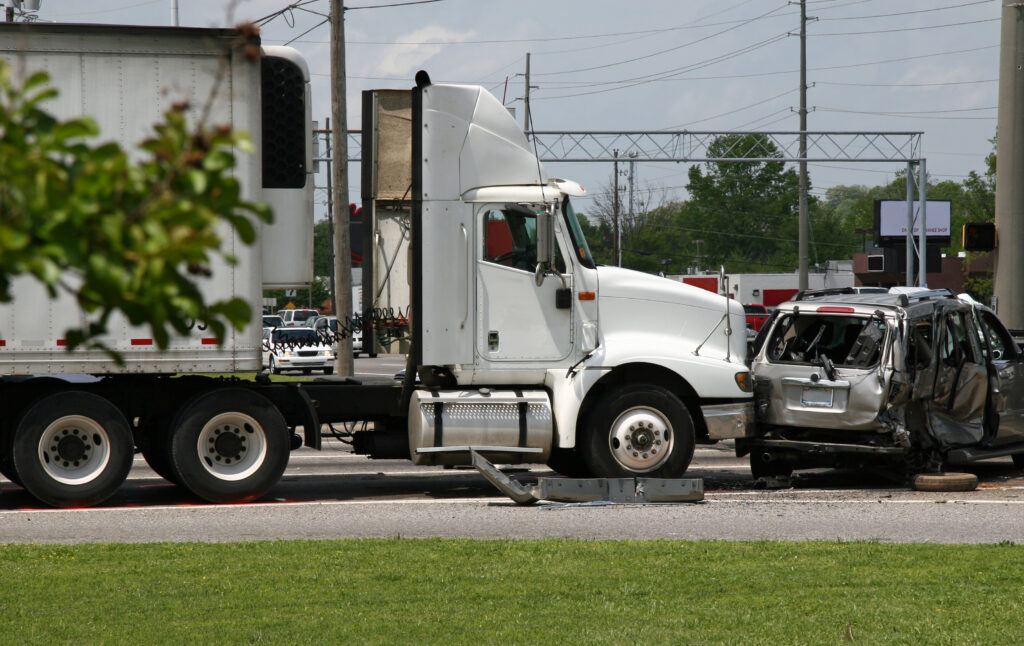

Fault after a South Carolina truck accident is determined by investigating what caused the crash and assigning each responsible party a percentage of the blame. That can fall on the truck driver, the trucking company, or both, and it’s proven with evidence such as driver logs, truck data, maintenance records, and the police report. If you were partly at fault, you may still recover compensation as long as your share is 50 percent or less.
The Insurance Institute for Highway Safety (IIHS) reports that large trucks can weigh 20 to 30 times as much as a passenger car, and that 5,340 people died in large truck crashes in 2024. Sixty-two percent of them were occupants of cars and other passenger vehicles. Knowing how fault works is the first step in protecting your truck accident claim.
How is fault decided in a South Carolina truck crash?
South Carolina is an at-fault state, which puts the cost of a crash on whoever’s negligence caused it. Insurance companies review the evidence first. If the claim isn’t resolved, a jury can assign each party a percentage of fault. In a truck case, the questions are usually the same:
- What did the driver do before the crash?
- Did the driver and company follow federal safety rules?
- Did the company’s own choices about hiring, training, or maintenance play a part?
How does comparative negligence work if you were partly at fault?
South Carolina follows modified comparative negligence, a rule from the 1991 case Nelson v. Concrete Supply Co. You can recover if your negligence is not greater than the defendant’s, which in practice is 50 percent or less, and your compensation is reduced by your share. At 51 percent or more, you can’t recover.
A separate law changed on January 1, 2026. Act 42 amended South Carolina Code Section 15-38-15 for claims arising after that date. Generally speaking, a defendant found less than 50 percent at fault isn’t jointly and severally liable (responsible for all of the damages); a defendant at 50 percent or more still is, and juries can now assign fault to people who aren’t parties to the case.
What evidence proves fault in a truck accident?
Much of the key evidence is held by the trucking company, and rules from the Federal Motor Carrier Safety Administration (FMCSA) set how long some of it must be kept. It includes:
- Driver logs: Electronic logging devices show whether hours-of-service limits were exceeded. Carriers must keep them for only six months.
- Black box data: Many trucks record speed and braking, which can show how the driver reacted.
- The driver qualification file: It shows whether the company properly checked the driver before hiring.
- Maintenance records: They show whether brakes, tires, and other safety systems were inspected and repaired.
- The police report: It’s important evidence, but it isn’t the final word on fault.
Because records can be overwritten or discarded, a request to preserve them should go out early. Our post on how FMCSA rules affect your truck accident claim explains which records carriers must keep.
Three ways fault is shown in a truck crash
1. Hours-of-service violations
Federal rules allow a maximum of 11 hours of driving after 10 consecutive hours off duty, and a driver may not drive beyond the 14th consecutive hour after coming on duty. A 30-minute break is required after 8 cumulative hours of driving. See the full FMCSA summary of hours-of-service rules. When logs show a driver went past these limits, that’s strong evidence of fault.
2. Driver fatigue
A tired driver reacts late, and IIHS reports that loaded tractor-trailers need 20 to 40 percent more distance than cars to stop. Fatigue, like a distracted truck driver, can be shown through logs, delivery schedules, and the truck’s own data.
3. A poor driving record
Companies must make sure the drivers they put on the road meet commercial license standards. Hiring or keeping a driver with a poor record can be the company’s own act of negligence.
How can fault be shared between the driver and the trucking company?
A company can be responsible for a driver’s actions on the job, and also for its own decisions about hiring, training, and maintenance. The percentages assigned to the injured person and each defendant add up to 100. Our article on who is liable in a truck accident explains how employment status and leased trucks affect that split between the driver and the company.
Frequently asked questions
Does the police report decide who is at fault?
No. It’s important evidence, but insurers and, if a lawsuit is filed, a jury decides fault after reviewing everything. A report can also miss records only the trucking company holds.
Can the trucking company be at fault if its driver caused the crash?
Yes. A company can be responsible for its driver’s actions on the job and for its own decisions. Both can be found at fault in the same case.
What if the trucking company says the crash was partly my fault?
Partial blame doesn’t automatically end a claim. At 50 percent or less, your recovery is reduced by your share. At 51 percent or more, you can’t recover.
Can truck data and driver logs be lost?
Yes. Some data can be overwritten, and federal rules let carriers discard driver logs after six months, so an early request to preserve evidence matters.
Does breaking a federal safety rule prove the driver was at fault?
Not on its own. A violation is strong evidence when it’s tied to the cause of the crash, but fault depends on all the facts.
Speak With a Greenville Personal Injury Lawyer
If an accident or negligent act has caused a serious injury, you do not have to deal with the legal process alone. Speak with Thomas Creech Law Offices to understand your options and the next steps in your case. Contact our personal injury law firm in Greenville, SC, to request a free consultation.
This article is general information, not legal advice, and reading it or contacting the firm doesn’t create an attorney-client relationship.